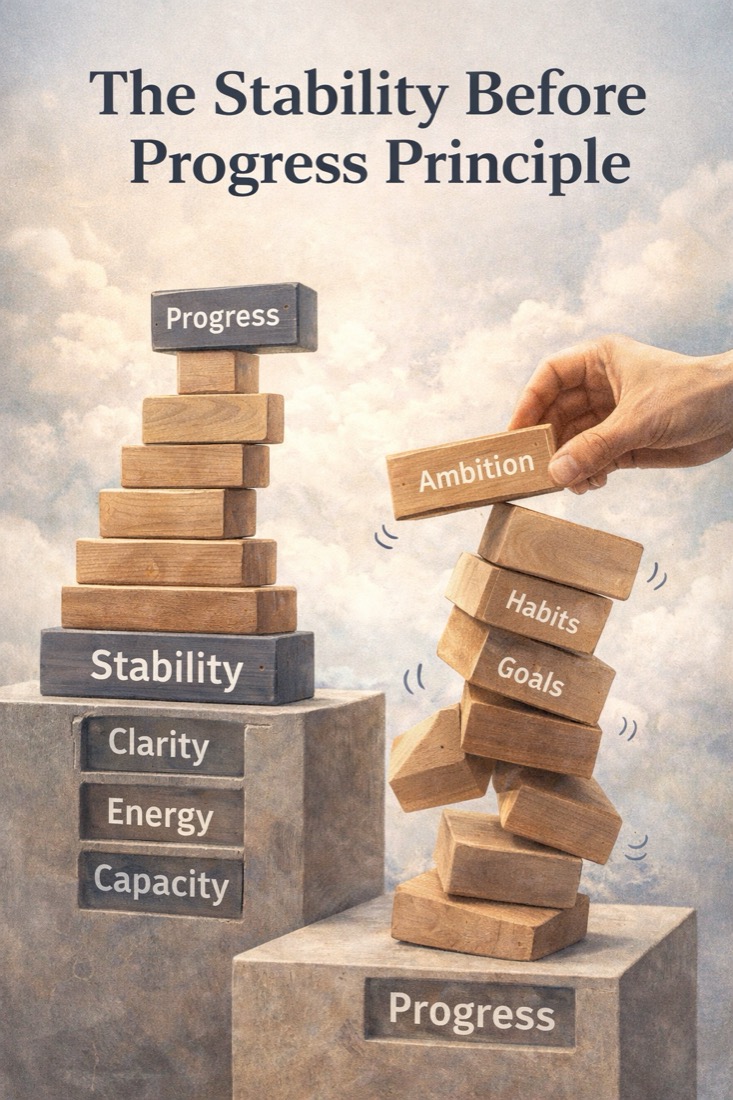
You don't need to level up.
You need to stabilize.
Most people try to improve their life while standing on unstable ground.
More goals.
More habits.
More ambition.
But no foundation.
That's why progress feels exhausting.
Why Self-Improvement Often Backfires
Search for productivity advice and you'll find:
- Wake up at 5 AM
- Build 10 habits
- Optimize your morning
- Track everything
- Hustle harder
None of this works if your internal system is unstable.
When your nervous system is overloaded, your mind is noisy, and your decisions feel heavy, adding more structure creates more friction.
And friction leads to avoidance.
If you haven't read it yet, start with:
👉 Why Your Mind Feels Noisy All the Time
Because clarity is the first layer.
Stability is the second.
What Stability Actually Means
Stability is not stagnation.
It's not lowering your ambition.
It means:
- Predictable baseline energy
- Reduced cognitive overload
- Fewer open loops
- Clear next actions
- Emotional regulation
Stability is a regulated system.
Progress without regulation equals burnout.
The MindFormFunction Model: Stability → Capacity → Progress
This is the core sequence.
1️⃣ Stability
Reduce noise. Close open loops. Regulate inputs.
2️⃣ Capacity
When mental bandwidth increases, your usable energy expands.
3️⃣ Progress
With higher capacity, growth feels natural — not forced.
Most people reverse this order.
They chase progress first.
Then wonder why they collapse.
Why Motivation Is a Weak System
Motivation fluctuates.
Structure stabilizes.
If your productivity relies on motivation, it will always feel fragile.
Stability removes the need for constant emotional intensity.
It replaces:
"I hope I feel like it."
With:
"This is manageable."
And manageable beats exciting every time.
Signs You're Skipping Stability
You may be bypassing stability if:
- You constantly redesign your routine
- You start habits but don't sustain them
- You feel productive for 3 days, then crash
- You consume productivity content but don't execute
- You feel overwhelmed before you even begin
These are not discipline failures.
They're system failures.
How to Build Stability (Practical Framework)
Let's make this concrete.
Step 1: Reduce Active Goals to Three
More goals = more cognitive tabs.
Three active priorities at a time.
Everything else is parked.
Step 2: Install a Daily Reset Window
Five to ten minutes daily.
Close open loops.
Clarify tomorrow's first action.
Remove friction.
If you need a structured format, start with:
This is your stabilization tool.
Step 3: Remove One Source of Recurring Friction
Examples:
- Unclear morning routine
- Disorganized workspace
- Unscheduled deep work
- Digital clutter
Fix one recurring friction point.
Not everything.
Just one.
Stability compounds.
The Psychological Shift
When stability increases:
- Anxiety decreases
- Procrastination drops
- Energy smooths out
- Execution becomes consistent
You stop needing emotional hype.
You start operating from structure.
This is where sustainable productivity lives.
Why Stability Feels "Slow" (But Wins Long-Term)
Stability is quiet.
It doesn't give dopamine spikes.
It gives:
- Predictability
- Calm momentum
- Sustainable output
That's why people abandon it.
It doesn't feel dramatic.
But it works.
The Reset as a Structural Tool
If mental clarity removes noise, stability requires architecture.
That's what MindFormFunction: The Reset was built to support.
It's not a motivation workbook.
It's a structural system for:
- Reducing cognitive overload
- Designing personal stability
- Building usable mental capacity
- Creating a mind that works
Explore it here: 👉 The Reset
Final Thought
Progress is not the first step.
Stability is.
If you're tired of starting over, stop chasing growth.
Build a base strong enough to support it.
Stability → Capacity → Progress.
In that order.
—
MindFormFunction
Tools for a mind that works.